
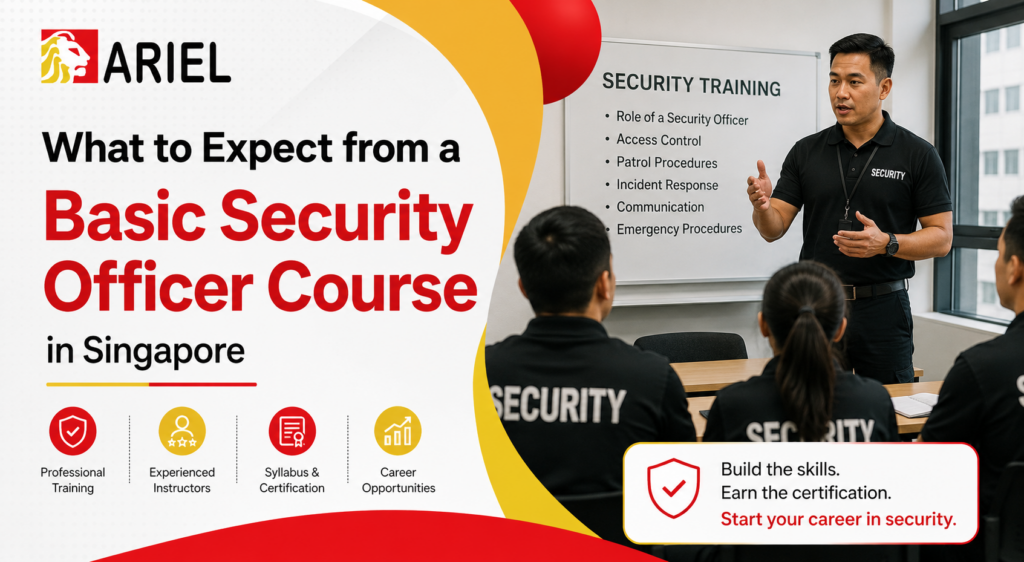
If you are considering a career in the private security industry, you may be wondering what actually happens during a basic security officer course in Singapore. Is it mainly classroom learning? Will you practise real workplace situations? What subjects will you study, and how does the training connect with the requirements for becoming a licensed Security Officer?
A basic course is designed to build the foundational knowledge and practical skills needed for security work. In Singapore, the training framework for Security Officers includes areas such as handling security incidents, guard and patrol duties, recognising terrorist threats and operating basic security equipment.
For someone new to the industry, understanding these requirements before enrolling can make it easier to choose suitable security officer training in Singapore and prepare for the learning experience.
Key Takeaway
A basic security officer course is more than learning how to stand at an entrance or patrol a premises. You can expect training related to access control, patrol procedures, incident handling, threat awareness, basic security equipment, communication and workplace responsibilities.
In Singapore, the Police Licensing & Regulatory Department (PRD) states that a Security Officer must complete the relevant mandatory Workforce Skills Qualifications (WSQ) modules required for the Security Officer grade. The current listed mandatory modules are Handle Security Incidents and Services, Provide Guard and Patrol Services, Recognise Terrorist Threats, and Operate Basic Security Equipment.
What Is a Basic Security Officer Course?
A basic security officer course introduces learners to the knowledge and competencies expected in entry-level security work.
The exact course structure, delivery method and assessment arrangements can differ between training providers. However, the broader occupational framework gives a useful picture of what a new Security Officer needs to understand.
According to Singapore’s Skills Framework for Security, Security Officers may perform duties involving access control, security screening, patrolling, guarding premises, responding to incidents and assisting authorities when required. The role can also involve interacting with visitors, employees and other stakeholders.
This means that training is not limited to physical security. Communication, observation, decision-making and following established procedures are also important.
For learners comparing courses, Ariel Security Academy is one Singapore-based training provider you can review when researching available options and course information.
What Will You Learn in a Basic Security Officer Course?
While individual course structures can vary, Singapore’s current requirements provide a clear indication of the core areas that new Security Officers need to cover.
1. Handling Security Incidents
Security Officers may encounter situations ranging from access-related problems to incidents requiring escalation or assistance from other parties.
Training in incident handling helps learners understand how to:
- Recognise an incident
- Follow established procedures
- Gather and communicate relevant information
- Respond appropriately
- Record important details
- Escalate situations when necessary
- Support emergency responses
The objective is not to encourage unnecessary confrontation. Instead, learners need to understand their responsibilities and the appropriate response within the limits of their role.
This is particularly important because security work often involves making decisions under pressure while remaining calm and following procedures.
2. Guarding and Patrol Duties
Patrolling is one of the fundamental functions associated with security work.
A basic security training Singapore programme may introduce learners to the principles behind effective patrols, including observation, checking designated areas, identifying unusual conditions and reporting concerns.
The Skills Framework for Security describes Security Officers as being responsible for protecting assigned premises, assets and personnel, with duties that can include conducting security patrols and guarding premises.
A useful way to think about patrol training is that it is not simply about walking around a building.
A good patrol requires attention to the environment.
For example, a Security Officer may need to notice:
- An unsecured access point
- An unfamiliar person in a restricted area
- An unusual object
- Damage to property
- A malfunctioning security device
- An environmental condition that could create a risk
The ability to observe and report accurately can be just as important as physical presence.
3. Recognising Security and Terrorist Threats
Threat awareness is another important part of the basic training framework.
The mandatory WSQ requirements for Security Officers include Recognise Terrorist Threats.
The purpose of this training is to help Security Officers recognise indicators that may require attention and respond according to established procedures.
Learners should understand the difference between simply noticing something unusual and responsibly reporting a potential concern.
For example, a suspicious item should not automatically be treated as an emergency based purely on assumption. A Security Officer needs to understand the appropriate reporting and response process.
4. Operating Basic Security Equipment
Modern security work often involves equipment rather than relying entirely on physical observation.
Singapore’s current Security Officer training requirements include Operate Basic Security Equipment as one of the four mandatory WSQ modules for the Security Officer grade.
Depending on the workplace and role, security personnel may encounter equipment used for access control, surveillance, alarms or other security functions.
The key lesson for a beginner is that equipment is a support tool. Knowing what a system is designed to do, how to use it correctly and what to do when something appears abnormal can form part of day-to-day responsibilities.
Is a Basic Security Officer Course Mostly Classroom-Based?
Not necessarily.
Security training involves knowledge, procedures and practical application. Even when part of the learning takes place in a classroom, students should expect examples and exercises that connect concepts to workplace situations.
For instance, instead of only discussing access control as a definition, training may involve considering how an officer should respond when:
- A visitor cannot provide the required information
- Someone attempts to enter a restricted area
- A person disputes an access decision
- A security incident develops at an entrance
- A situation needs to be escalated
This practical approach matters because security officers work with people as well as procedures.
The Skills Framework also identifies communication, service orientation, teamwork, problem-solving and digital literacy among the generic competencies associated with the Security Officer role.
What Does Assessment Usually Test?
Assessment requirements depend on the specific module and training provider, so prospective students should check the current course information before enrolling.
Generally, however, learners should be prepared to demonstrate that they understand the required knowledge and can apply it appropriately.
This is why memorising definitions alone may not be enough.
A learner could know the meaning of “access control” but still need to demonstrate that they understand how access-related situations should be managed in practice.
Singapore’s Police Licensing & Regulatory Department notes that mandatory WSQ certifications are linked to the functions Security Officers are authorised to perform under the Security Progressive Wage Model.
Assessment should therefore be viewed as part of learning how to perform the role responsibly, rather than simply as a test to complete.
What Skills Should You Build Before Starting?
You do not need to arrive as an experienced security professional.
However, several habits can make training easier.
Communication
Security Officers interact with visitors, colleagues, supervisors and other stakeholders. Being able to communicate clearly and respectfully is important.
Observation
Good observation involves noticing relevant details rather than simply looking around.
Listening
Following instructions accurately can be important when dealing with procedures, incidents and workplace directions.
Responsibility
Security work involves protecting premises, property and people. Taking procedures seriously is therefore essential.
Basic Digital Skills
Security work increasingly involves technology and equipment. Basic digital confidence can help when learning systems and recording information.
These expectations align with the Skills Framework’s identified generic competencies for Security Officers.
How Does Security Officer Training Connect to Licensing?
This is one of the most important points for anyone researching a security officer qualification in Singapore.
Completing a course and obtaining a Security Officer licence are related but should not be treated as exactly the same thing.
The Singapore Police Force states that a Security Officer licence is required for specified functions, including guarding or patrolling another person’s property, keeping property under surveillance, acting as a bodyguard or bouncer, certain screening functions and regulating traffic under the Road Traffic Act.
The current licensing information also states that applicants must meet eligibility requirements, including being a Singapore Citizen, Singapore Permanent Resident or, in the applicable case, holding a valid work pass as a Malaysian citizen. Applicants must also meet the relevant licensing criteria.
Therefore, before enrolling, it is sensible to distinguish between:
Training:
Learning and completing the required competencies or modules.
Certification:
Receiving the applicable WSQ certification or other recognised training record after meeting the relevant requirements.
Licensing:
Meeting the Singapore Police Force’s requirements to obtain a Security Officer licence.
Understanding these differences can prevent confusion when comparing training providers.
What Should You Look for When Choosing Security Officer Training in Singapore?
Not every learner has the same needs. A person entering the industry for the first time may need a different training pathway from an existing officer seeking additional competencies.
Before registering, consider the following.
Check the Current Course Requirements
Training requirements can change. Singapore’s Police Licensing & Regulatory Department currently lists four mandatory WSQ modules for the Security Officer grade.
Confirm that the course you are considering corresponds to the current requirements applicable to your situation.
Check the Assessment Format
Ask how assessments are conducted and what preparation is provided.
Knowing whether assessment involves written work, practical activities or other methods can help you prepare appropriately.
Consider Practical Learning
Security work is practical by nature. Look for training that helps you understand how concepts apply to realistic workplace situations.
Review Eligibility
Do not assume that every applicant automatically qualifies for a Security Officer licence.
Check the official licensing criteria before making a decision. The Singapore Police Force provides the current application requirements and supporting-document information.
Ask About Course Support
If you are new to the industry, consider whether the provider clearly explains the course structure, assessment expectations and relevant next steps.
A provider’s ability to explain the process clearly can be useful for first-time learners.
Common Mistakes to Avoid
Choosing training simply because it appears to be the cheapest or shortest option can create problems later.
Here are several mistakes worth avoiding.
Mistake 1: Assuming Any Security Course Leads to a Licence
A course certificate does not automatically mean that every licensing requirement has been satisfied.
Always distinguish between training certification and the Security Officer licensing process.
Mistake 2: Ignoring Current Requirements
Training frameworks can be updated.
For example, the Singapore Police Force currently lists specific mandatory WSQ modules for Security Officers and has also published updates affecting training requirements for existing officers.
Always verify current requirements rather than relying on an old article, social media post or outdated course description.
Mistake 3: Focusing Only on Passing the Assessment
Passing an assessment is important, but the ultimate purpose of training is to develop workplace competence.
Try to understand why procedures exist and how they apply to different situations.
Mistake 4: Underestimating Communication Skills
Security Officers are not isolated from the public.
The role can involve visitors, employees, clients, contractors and other stakeholders. Clear and professional communication is therefore part of effective security work.
Mistake 5: Choosing Without Checking the Details
Before registering, compare course content, prerequisites, assessment arrangements, schedule and the certification involved.
A few minutes of research can help you select a course that matches your actual career goal.
What Is the Difference Between Basic Training and Advanced Security Training?
A basic programme is generally the starting point for someone developing foundational competencies.
As officers progress, additional responsibilities can require further training.
For example, Singapore’s current framework includes higher grades such as Senior Security Officer and Security Supervisor, with additional training and experience requirements.
This means your first course does not necessarily represent the end of your learning journey.
A possible progression can involve:
Basic training → Security Officer role → Additional experience and training → Higher security responsibilities
The exact pathway depends on your qualifications, work experience, employer requirements and the applicable regulatory framework.
What Should You Expect on Your First Day?
If you have never taken security training before, the first day may feel unfamiliar, but the learning generally starts with understanding the role and its responsibilities.
You may encounter:
- Course orientation
- An introduction to security duties
- Learning objectives and assessment information
- Basic terminology
- Workplace scenarios
- Discussions about procedures
- Trainer-led activities
- Questions and practical examples
Do not worry about already knowing everything.
The purpose of entry-level training is to develop the foundation you need to understand the role.
Come prepared to participate, ask questions and pay attention to how procedures are applied in realistic situations.
Is a Basic Security Officer Course Suitable for You?
This type of training may be worth considering if you:
- Are exploring an entry-level career in the security industry
- Want to understand the responsibilities of a Security Officer
- Need the relevant training pathway for the role
- Prefer structured learning before entering the workplace
- Want to build foundational security competencies
It may be less appropriate to choose an entry-level course without checking first if you already have relevant qualifications, experience or a different target role.
In those situations, checking the applicable training and licensing pathway can prevent unnecessary training.
How Can You Prepare for the Course?
A little preparation can make the learning experience smoother.
Read the Course Information Carefully
Understand the course duration, schedule, prerequisites and assessment arrangements before registering.
Familiarise Yourself With the Role
Read about what Security Officers actually do. This gives you context when you encounter concepts such as access control, patrols, incident response and surveillance.
Improve Your Communication
Practise explaining information clearly and listening carefully.
Take Practical Scenarios Seriously
When trainers provide examples, think about what you would actually do rather than only trying to remember the “correct” sentence.
Keep Your Training Records
The Singapore Police Force notes that training records and certifications are relevant to Security Officer licensing and employment-related checks.
Keeping your documents organised can make future administrative steps easier.
What Happens After Completing the Training?
Completing the relevant training is an important part of preparing for security work, but it is useful to look at the bigger picture.
You may need to consider:
- Whether you have completed the applicable mandatory training.
- Whether you have received the relevant certification or Statement of Attainment.
- Whether you meet the Security Officer licensing requirements.
- Whether you have the documents required for the licence application.
- What type of security role you want to pursue.
The Singapore Police Force provides the official process for applying for a Security Officer licence, including application requirements and supporting documents.
If you are comparing providers, Ariel Security Academy’s course information can be reviewed alongside the official requirements so you can better understand how a training programme fits into your intended pathway.
Frequently Asked Questions
1. What is covered in a basic security officer course in Singapore?
The foundational Security Officer training framework covers areas including handling security incidents and services, guard and patrol services, recognising terrorist threats and operating basic security equipment.
2. Is a basic security officer course enough to become a licensed Security Officer?
Training is an important part of the process, but completing a course should not be confused with automatically receiving a Security Officer licence. Licensing is subject to the Singapore Police Force’s eligibility and application requirements.
3. What qualifications are needed for Security Officer training?
The applicable requirements depend on the specific training and licensing pathway. Prospective learners should check the current course prerequisites and the Singapore Police Force’s licensing criteria before registering.
4. Does security officer training include practical learning?
Security work involves practical duties such as access control, patrols, incident response and use of security equipment. Training providers may use different teaching and assessment methods, so it is useful to check the specific course structure before enrolling.
5. What skills are useful for a new Security Officer?
Communication, observation, teamwork, problem-solving, service orientation and basic digital literacy are among the competencies identified in Singapore’s Skills Framework for Security.
6. Can I progress to a higher security position after basic training?
Yes, security career pathways can include higher grades such as Senior Security Officer and Security Supervisor. These positions have additional training and experience requirements.
7. How do I choose security officer training in Singapore?
Compare the current course requirements, training content, assessment method, schedule, prerequisites and certification provided. Also confirm that the training fits the licensing or employment pathway you are pursuing.
8. Do Security Officers need ongoing training?
Training requirements can apply beyond initial entry-level preparation. For example, the Singapore Police Force has announced mandatory additional modules for existing Security Officers and Senior Security Officers, with a current deadline of 31 December 2026 for the specified modules.
9. Where can I find official Security Officer licensing information?
The Singapore Police Force’s Security Officer licensing pages provide current information on eligibility, applications, documents and licensing requirements.
Conclusion
A basic security officer course in Singapore should give you a clear foundation in the responsibilities, procedures and competencies involved in entry-level security work. Rather than focusing only on completing a certificate, look for training that helps you understand how to respond to real workplace situations involving access control, patrols, incidents, threats and security equipment.
It is equally important to understand the difference between training, certification and licensing. Singapore’s current framework sets specific mandatory WSQ modules for the Security Officer grade, while the Singapore Police Force separately sets the requirements for obtaining a Security Officer licence.
If you are planning to begin security officer training in Singapore, review the course details carefully, compare them with the current official requirements and choose a learning pathway that matches your intended role. You can also review Ariel Security Academy’s available training information as part of your research before making an informed decision.